

The Indian fashion retail market is surging, with the broader e-retail market reaching $60 billion in GMV. Within this landscape, independent Jaipur apparel boutiques are systematically losing market share. However, a glaring paradox exists: independent Jaipur apparel boutiques are systematically losing market share to centralized e-commerce behemoths such as Myntra, Nykaa, and Meesho.
While traditional narratives attribute this to venture capital and deep discounting, the reality is that local boutiques are engaged in an asymmetric “visibility war.” Physical inventory and heritage craftsmanship are consistently defeated by superior digital discoverability and rigorous data-driven performance marketing. Local retailers are losing because of a profound misunderstanding of advanced digital metrics. Here is the definitive framework of the exact digital gaps causing this loss.
The Disconnect Between Craftsmanship and Search Intent
The fundamental flaw in local digital strategy is treating social media as a broadcast tool rather than an acquisition engine. While local boutiques focus on aesthetic grid layouts and branded search terms, e-commerce giants deploy highly sophisticated SEO frameworks to capture high-intent buyers.
Myntra‘s ‘Taavi’ brand is a masterclass in algorithmic arbitrage. By adapting traditional crafts (like Bagru and Sanganeri prints) and rigorously optimizing Product Detail Pages (PDPs) with long-tail, high-intent keywords, Myntra captures transactional search traffic. Local Jaipur boutiques, which possess the authentic inventory, remain invisible to search algorithms because they lack technical SEO foundations and structured data. This forces them to rely on low-intent, high-friction channels.
| SEO Strategy Component | Local Jaipur Boutique Execution | Myntra / E-Commerce Giant Execution | Impact on Market Share |
| Keyword Targeting | Generic, branded terms (e.g., “Jaipur Boutique”). | Granular, transactional long-tail keywords (e.g., “Sanganeri print A-line kurta cotton”). | Giants capture 90% of non-branded, high-intent search traffic. |
| Site Architecture | Flat, unstructured product listings with minimal categorization. | Deeply nested, thematic content silos with optimized category and sub-category landing pages. | Giants achieve superior crawlability, indexation, and topical authority. |
| Technical SEO Elements | Missing alt text, lack of schema markup, unoptimized meta descriptions. | Rigorous implementation of structured data (Product Schema, Review Schema) and dynamic metadata. | Giants dominate rich snippets and visual search results, drastically improving Click-Through Rates (CTR). |
Core Web Vitals (CWV) and the Financial Cost of Latency
Even when local Jaipur boutiques successfully drive traffic, they face a catastrophic drop-off at entry. This friction is quantified by Google’s Core Web Vitals (CWV). Staggeringly, 60% of Indian websites fail these baseline standards in 2026. For apparel e-commerce, latency represents a direct hemorrhage of top-line revenue.
Local boutiques frequently upload massive, uncompressed high-resolution images, severely inflating the Largest Contentful Paint (LCP) past the 2.5-second benchmark. The business impact is devastating: product pages experience 40% to 50% lower Conversion Rates (CR) when users encounter a 4-second LCP compared to a 2-second LCP. While local boutiques struggle with bloated DOM sizes and slow server response times, giants like Myntra utilize Server-Side Rendering (SSR) and WebP image compression to guarantee near-instantaneous mobile rendering.
| Core Web Vital Metric | E-Commerce Giant Optimization Tactics | Local Boutique Common Failures | Revenue Consequence of Failure |
| LCP (Largest Contentful Paint) | Server-Side Rendering (SSR), next-gen image formats (WebP), Content Delivery Networks (CDNs). | Uploading raw, 5MB+ JPEG images; lacking browser caching; cheap, shared hosting. | 40-50% drop in conversion rates for load times exceeding 4 seconds. |
| INP (Interaction to Next Paint) | Deferring non-critical JavaScript, utilizing web workers, minimizing main-thread execution time. | Heavy reliance on bloated Shopify apps, synchronous loading of heavy third-party tracking scripts. | Users click “Add to Cart,” experience no visual feedback, click again, and ultimately abandon the site in frustration. |
| CLS (Cumulative Layout Shift) | Explicitly defining image dimensions in CSS, pre-allocating space for dynamic ad banners. | Web fonts loading late (FOUT/FOIT), dynamically injected promotional banners pushing content down. | Users accidentally click incorrect product variants or navigational links, destroying brand trust and increasing bounce rates. |
The Meta Pixel Catastrophe and the Retargeting Blind Spot
The lifeblood of modern apparel e-commerce is paid social acquisition. However, independent Jaipur retailers often execute “vanity marketing,” utilizing the basic “Boost Post” functionality and targeting broad demographics.
In performance marketing, top-of-funnel engagement is meaningless unless it translates to revenue. Local boutiques systematically mismanage their Meta Pixel architecture. Common failures include duplicate pixel firing (which corrupts the algorithm with inflated data) and ignoring the Conversions API (CAPI). Without CAPI, local boutiques lose up to 40% of their conversion data due to browser restrictions and ad-blockers.
Consequently, local boutiques cannot effectively execute dynamic retargeting. Platforms like Meesho and Nykaa deploy sophisticated Dynamic Product Ads (DPAs) to retarget users with the exact SKU they abandoned. Without this capability, local retailers continuously burn budgets acquiring cold traffic.
The Illusion of ROAS vs. the Reality of POAS
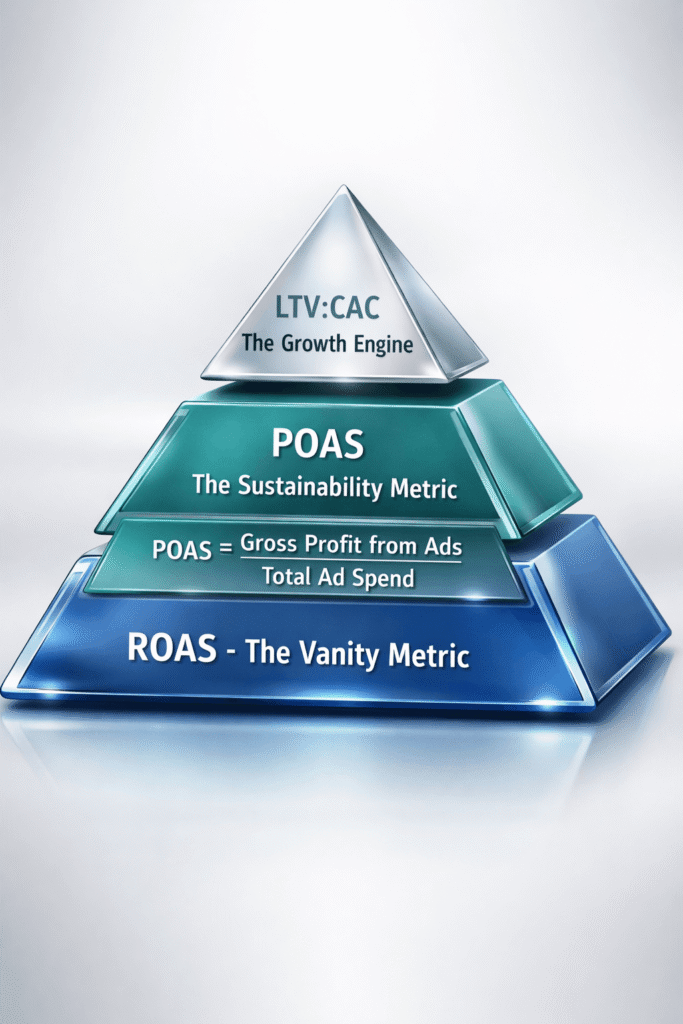
Generating a high Return on Ad Spend (ROAS) is universally touted as the primary metric for sustainability. If a boutique spends ₹10,000 on ads and generates ₹70,000, they achieve a 7x ROAS. However, ROAS is fundamentally flawed without context. If a boutique operates on narrow 30% gross margins due to premium artisan labor, a 3x ROAS actually results in a net financial loss once the Cost of Goods Sold (COGS) and logistics are factored in.
E-commerce giants optimize strictly for Profit on Ad Spend (POAS) and Customer Lifetime Value (LTV).
| Financial Metric | Mathematical Definition | Strategic Focus | Utility for Scaling E-Commerce |
| ROAS (Return on Ad Spend) | Total Ad Revenue / Total Ad Spend | Top-line gross revenue generated directly by advertising. | Useful for evaluating immediate, relative ad platform efficiency, but entirely blind to product margins and operational costs. |
| POAS (Profit on Ad Spend) | Gross Profit from Ads / Total Ad Spend | Bottom-line net profitability of advertising efforts. | Essential for sustainable, long-term scaling; ensures the business actually generates free cash flow on a transaction. |
| LTV:CAC Ratio | Customer Lifetime Value / Customer Acquisition Cost | Long-term profitability of acquiring a specific customer cohort. | Allows venture-backed giants to take a deliberate net loss on the first purchase to secure a highly profitable, recurring buyer over a 12-24 month horizon. |
Conclusion: Reclaiming Digital Real Estate
Jaipur’s rich legacy of textile craftsmanship remains highly sought after. However, surviving in the 2026 digital landscape requires a total cessation of vanity marketing. Commercial success is no longer dictated solely by product quality, but by the speed of the LCP, the accuracy of server-side tracking, and the mathematical application of POAS.
To reclaim market share, local retail businesses must stop blindly boosting generic social media posts. Instead, they must benchmark their website’s Core Web Vitals, verify their Conversions API architecture, and structure product taxonomies to capture high-intent search queries. Audit your end-to-end digital sales funnel today to ensure your heritage craftsmanship isn’t lost in the digital void.